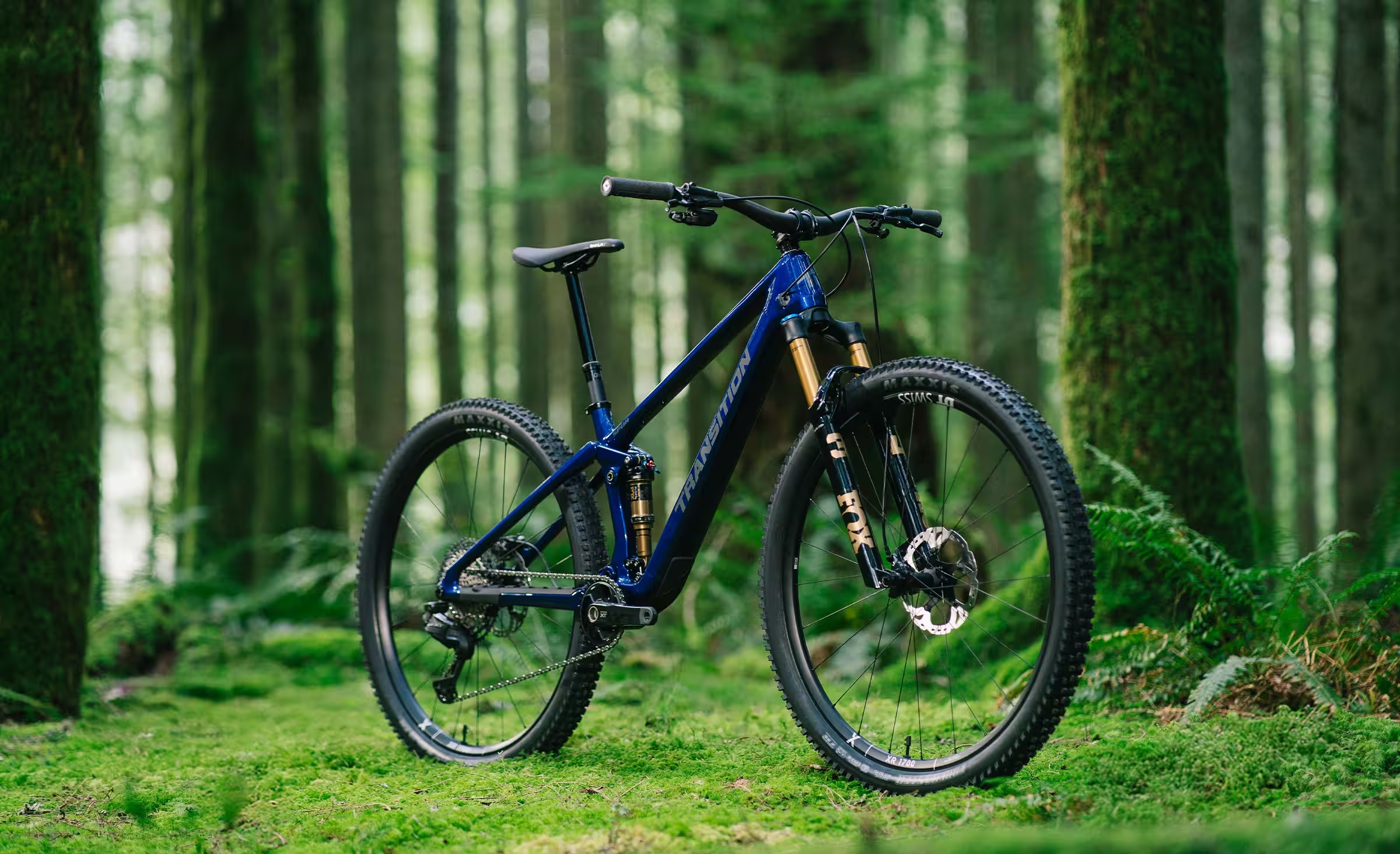
Transition shipped the Spur V2 yesterday. Six years to the month since the V1 launched and named a category that didn’t really exist yet, the Bellingham crew refreshed the bike that, more than any other, talked us into making this website.
Our family owns two Spur V1s. So before we get into the V2, full disclosure: we are biased. We think the original is the perfect downcountry bike. We have been quietly nervous about what Transition would do to it. The V2 is, by our reading, the V1 with a few tweaks around the margins. Ride character intact. We can exhale. Giddyup.
The bike launched March 3, 2026 at four complete trims: Eagle 70 ($5,499), Eagle 90 ($6,499), XT Di2 ($7,499), XTR Di2 ($10,999). Frameset is $3,599 if you would rather build it yourself.
What changed (and what didn’t)
V2 specifics: a flip chip at the lower shock mount drops the head angle from 66° to 65.5° and lifts the BB by 7mm. Size-specific chainstays, 435mm on S and M, ~440mm on L and XL (V1 was 435mm across every size). A Boom Box in-frame storage compartment. (Definitely not a SWAT Box, how dare you.) Cleaner internal cable routing. Stiffer front and rear triangles, addressing the V1’s occasional flex-stay flex under hard cornering loads. The 130mm fork is now standard across the build ladder.
What didn’t change is the part that matters most. 120mm of rear travel, kinematics carried over from the V1, the easy-pedaling-but-aggressive-descending ride character that made the original work. Transition told reviewers they specifically did not want to mess with the ride feel. Every V2 reviewer who has filed so far confirms they didn’t. Still a party in the woods.
What the day-one reviews say
Pinkbike’s Mike Kazimer titled his full review “Lightly Revised and Still Just as Fun,” which is a more polite version of what we wanted to say. Six years on, he wrote, the Spur is still “an absolute riot to ride on all sorts of terrain.” The Loam Wolf‘s Cole Gregg called the V2 “a full ground-up redesign of the original frame, while modernizing the character riders have grown to love.” Bike Magazine ran a launch-day first look that lands in the same neighborhood.
There is a pattern here. The Spur V1 launched in 2020, and Mike Levy’s Pinkbike Field Test that summer described the way the bike “delays what’s coming at you in a Matrix-y way.” The phrase stuck because it captured something specific, and what it captured is exactly what every V2 reviewer is now confirming Transition didn’t break.
Should V1 owners throw their bikes into the wood chipper?
Probably not.
The V2 fixes some things. The flex-stay sometimes felt flexy under hard cornering loads, and the V2 stiffens the rear triangle. The lack of in-frame storage was a real omission for a bike pitched at all-day backcountry rides, and the V2 adds the Boom Box. Cable routing through clamps on the down tube was a 2020 detail by 2025, and the V2 cleans it up.
The loam hat is an adorable name, and we’ve actually worried about getting a rock in the main pivot pocket that damages our frame.
All of that got addressed. None of it broke the V1 in the first place.
What you would notice if you swapped V1 for V2: a slightly tighter back end, a place to stash a tube and a snack, a head angle you can flip half a degree slacker on the days the trail wants it. What you would not notice: a different bike.
The Spur V1 was the proof of concept that the “downcountry” category actually meant something specific. Climbs efficiently, descends above its travel, does not pretend to be XC or trail. The V2 keeps all of that, and trims the rough edges.
We are going to ride our V1s into the ground first. When our mechanic tells us they’re too clapped to keep fixing, probably a V2.